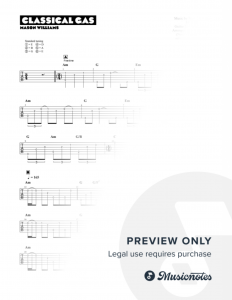
The Simpsons were actually a huge inspiration for this one. Seeing Lisa play Classical Gas years ago was one of the reasons I wanted to learn the song in the first place, so I thought it would be fun to give this tab a bit of a Simpsons theme.
This is the Mason Williams version, not the Tommy Emmanuel version. Tommy’s arrangement is way beyond my abilities, I have to admit. Tommy Emmanuel is one of the greatest acoustic guitar players ever, and I have nothing but respect for what he can do on the instrument. As always though, I like going back to the original recordings whenever possible.
That said, the version you’re hearing here is actually based on an alternate guitar-only recording of Classical Gas rather than the famous orchestral version most people know. If you search “Classical Gas Isolated” on YouTube, you’ll find the version I’m talking about. It’s essentially just the guitar part, and I’ve been playing that arrangement for close to 30 years. For this video, I adapted it with orchestral backing simply to fill things out a bit.
As for the fingerpicking, I don’t think there’s any single correct way to play it. My general approach is thumb for strings 6, 5, and 4, and index, middle, and ring for strings 3, 2, and 1. Depending on the passage, I’ll sometimes shift those fingers down a string set. For example, instead of G, B, and E, I may use D, G, and B. During some of the melody lines on the high E string, I’ll also alternate between using my middle finger and ring finger depending on what feels most comfortable.
One thing I wanted to point out for complete transparency involves measures 10, 29, and 86. When I originally recorded the intro, I played the F chord figure in measure 10 using the notes on strings 4 and 2. While editing, I realized Mason appears to play the same notes on strings 3 and 2 instead. Because of that discovery, I re-recorded the intro, which is why you’ll notice a cut between shots.
Later, I realized the same idea appears again in measures 29 and 86. In those spots, I left my original version intact. To my ears, both approaches work because the bass movement underneath supports either choice, and the difference is extremely subtle. Most listeners would never notice it, but I wanted to mention it anyway.
Finally, the tempo here may be slightly faster than the famous orchestral recording. After averaging the tempos from the isolated guitar version, I arrived at roughly 165 BPM. I believe the orchestral recording is a little slower, but I’ve always preferred the slightly quicker feel of the isolated guitar performance.
Hope you enjoy it, and thanks for playing along
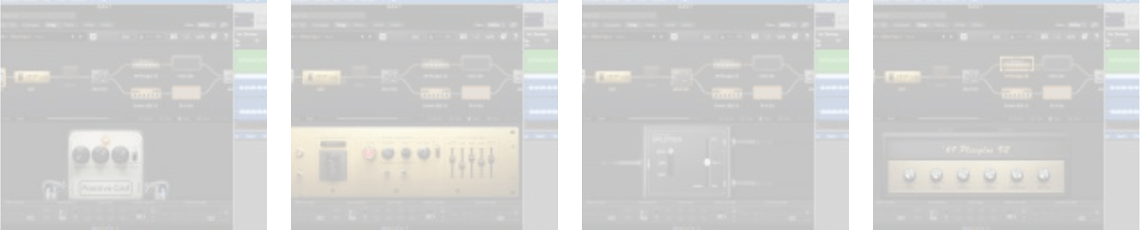
Tone are available as .AT5P Amplitube files
Please sign up on Patreon, or if you are already a member, please login.
Please sign up on Patreon, or if you are already a member, please login.
Please sign up on Patreon, or if you are already a member, please login.